0
Spoon Crooks
Spoon crooks, also called elbows, are the natural bend in a branch or small tree. This is the preferred wood for spoon carving. Crooks are most commonly caused by a branch taking a turn where a small limb protrudes or where one has broken off. Trees are full of crooks, naturally, but only a few are really ideal for spoon carving.
The first photo is a branch of a Birch tree that contains a fine spoon blank. The second photo is a closeup of this section.
Most ‘hard woods’ can make a fine spoon. Ideal are woods like birch, apple, maple…..that do not have a strong flavor (like black walnut does) and have fine dense grain. Dry dead branches rarely work because they have bug holes and cracks, and are very hard compared to green wood. Once a spoon is roughed out of green wood it may be easily dried without cracking, as long as you have left no pith (center) in it.
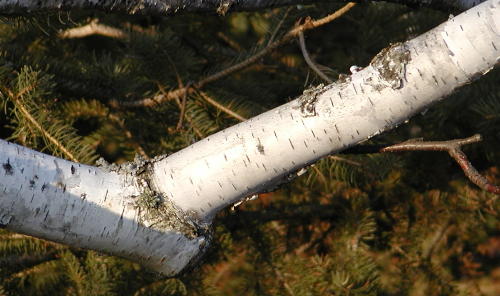

Ideally, the very best blank is the lower section of a crook. However, rarely is this piece useable because normally the bend is caused by a knot, (as in the above pics). When a bend is caused by outside natural forces, like snow load, then both sides are useable.
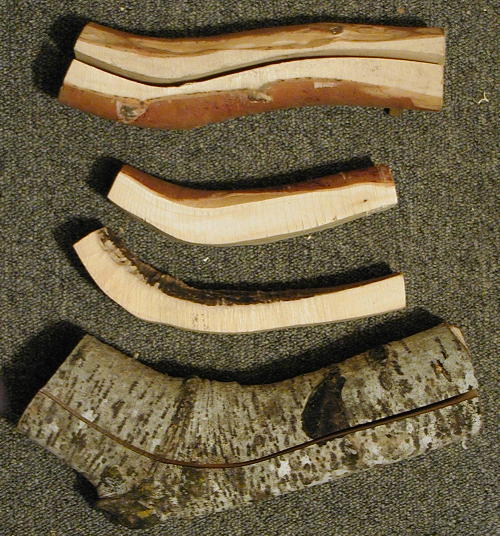
The blanks below can all make fine spoons. The 2 middle pieces are from the top of a branch and are partly bandsawed already.
 Both of these are great, as they have a double curve.
OK
OK
Only top is useable
(Bottom has a knot)
Working with green wood:
Why work green wood? Because it is much easier to cut than dry.
For newby’s to this I suppose the normal worry is “won’t it crack”? Think on this for a minute – all boards start out as green wood, just stacked up in open air with stickers between…..So, drying wood without cracking is no big deal at all….the secret is to make the end grain small in comparison to the side grain. For example: A 6″x 6″x 6″ cube of any wood will almost certainly crack, but a 1/8″ x 6″ x 6″ piece wouldn’t know how to crack from drying.
Boards 1″ thick sometimes do crack on just the very end, this is because the end grain is like the end of a hose, the moisture shoots out there way faster than the side of the hose, thus it has to shrink rapidly on the end – it’s uneven shrinkage that causes cracking. This effect is greatly worsened when the end of a board is cut at 90 degrees to the side grain – making it either pure severely shrinking end grain – or pure barely shrinking side grain. So…if one can make a gradual slope between the two then that is much kinder to the wood and greatly lessons the uneven shrinkage that causes cracking. (Boards by design need to have this perpendicular end grain cut, so to compensate a coating is used to slow down drying just on the end grain) A tradition in spoon carving from Sweden is to use a boiled potato to smear starch into end grain if there is a large section of it, but usually just roughing out the piece and slow air dry is quite adequate.
A well designed spoon blank is just that, it is all soft slopes between side and end grain, and what end grain is perpendicular to the side grain is kept to a bare minimum.
There is another equally important reason for this in spoon design: when a spoon enters hot water to be washed, or hot soup to be used – if a spoon has a flat wall of end grain somewhere – that area will swell more easily with exposure to water, then shrink more upon drying, this increases the incidence of cracking this spot later on in daily use. A well designed spoon or ladle can last for literally thousands of wettings and dryings without any warpage or cracking – this is the wonderful tradition that I learned from in northern Sweden. One ladle I copied while there was over a hundred years old, and had not a single crack. We have now used my copy continuously for over 20 years and it still looks great.
Drying time is hugely variable – It could take a day or a couple weeks once the spoon is fully carved – determined by thickness, drying conditions, original moisture…..dry wood is distinctly different than wet – one has to learn to judge by feel and sound and weight, it’s one of the fun challenges of spoon carving.
An important note, naturally anyone who works green wood will eventually have pieces that have cracked – keep them! study them! they contain very valuable information to learn from.
The other reason wood cracks – the heart or pith. The first few years of growth are a different structure of wood called ‘Juvenile Wood ‘it is more flexible and weaker, this is the ‘whip’ stage of a tree or branch. In most woods it is advisable to avoid this first 3 or 4 growth rings – even if they don’t crack at first – as the piece is drying they are more vulnerable to starting a crack in the future as a spoon is constantly going from wet to dry to wet.
Confusing terms: Heartwood is the section of darker rings in the center of a tree or branch (if it is old enough to contain heartwood), it no longer carries sap and the colors are from the extractives that help fight decay and insects. Heart center or pith means the very pinpoint center, the bulls eye, the first year of growth.
Finishing
Thi is from an email question, ” Is tung or flax seed oil a better finish for utensils”
I can’t possibly say, that would take long term side by side testing and i dont know of any. I’ve been treating heavily used utensils for 25 years with flax with great success, and the Swedes for 1,000 years. So I have never had reason to look into any other. (I never say linseed oil because, though it is supposedly 100% flax seed oil, I understand it often has chemicals in it if you buy from a hardware store.) Flax seed is sold for human consumption. I do not know if tung sold is ever for human consumption, so that is my personal basis for the decision.
Another access to flax seed oil that is pre-polymerized that is popular with serious spoon carvers is sold as Tried and True http://www.triedandtruewoodfinish.com/
Del
The next stage would be drawing a spoon shape on the blank and roughing out by bandsaw, coping saw, or carving axe. If you are cutting blanks for a future time, leave a couple inches extra wood on each end, and store in an airtight plastic bag in the freezer. They may be stored as full crooks, or as roughed out blanks.